

A canyon is a deep, narrow valley with steep sides, often carved by a river flowing through its center. These massive geological formations are some of the most spectacular natural wonders on Earth. They are not simply empty spaces in the ground. Instead, they are complex environments that tell a detailed story about the history of our planet. By looking closely at the structure of a canyon, we can learn exactly how water, wind, and time shape the world around us.
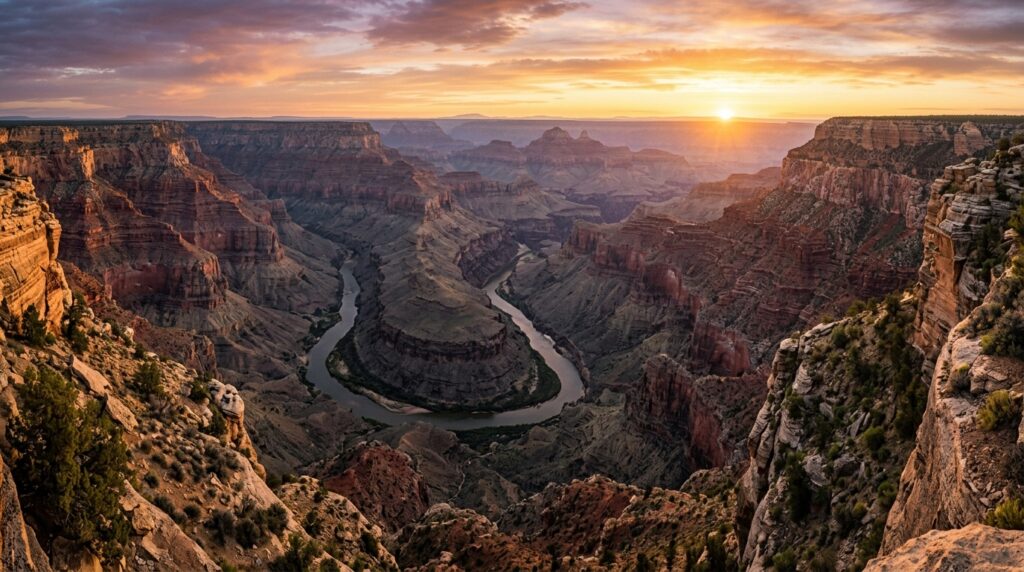
Understanding canyon structure matters for several reasons. Geologists study these formations to uncover millions of years of Earth’s history hidden in the stone. Ecologists explore them to find unique habitats that support rare plants and wildlife. For the rest of us, knowing how these massive valleys form adds a deep sense of wonder to any visit. When you stand on the edge of a famous landmark like the Grand Canyon, you are looking at a living textbook of geology.
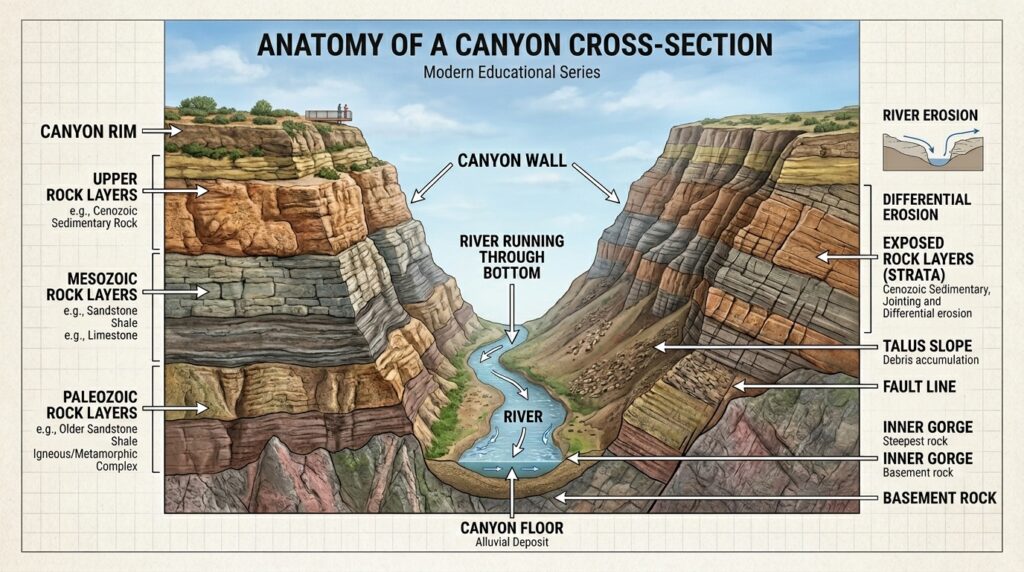
Every canyon consists of three main features: the walls, the floor, and the rock layers. The walls rise steeply to define the shape of the valley. The floor provides a foundation where rivers flow and sediment settles. The rock layers act as the building blocks, stacked over millennia and exposed by the forces of erosion. Together, these elements create the unique anatomy of a canyon.
What Makes Up a Canyon?
The basic geological structure of a canyon depends on a delicate balance of natural forces. A canyon begins to form when a river or stream starts cutting down into the bedrock. Over thousands or millions of years, the flowing water carries away dirt and stone, carving a deep trench into the earth.
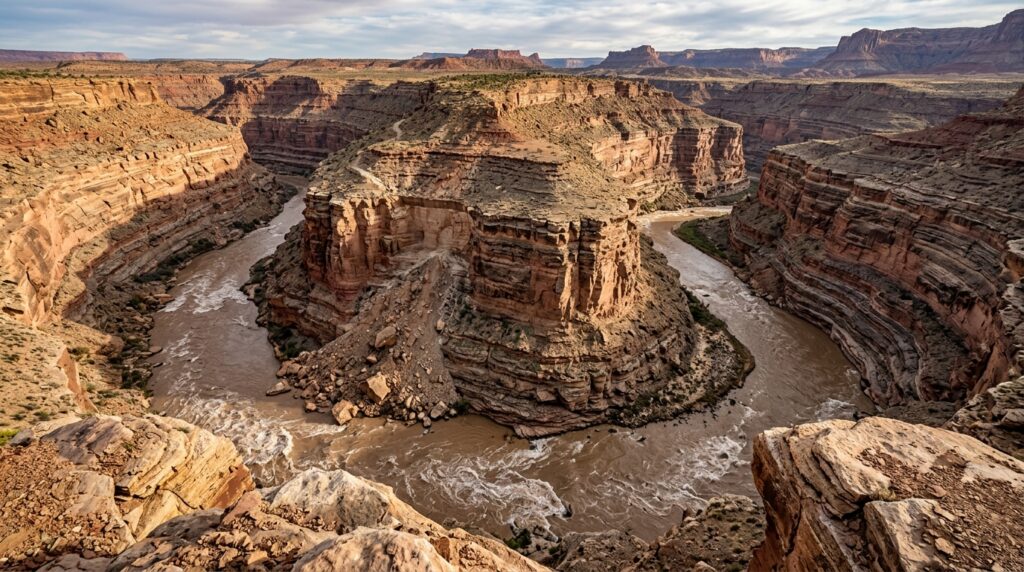
Canyons differ greatly in shape and size. Some are incredibly wide and deep, spanning miles across. Others are narrow and twisted, barely wide enough for a person to walk through. These differences come down to the relationship between erosion, rivers, and rock formations. A fast-moving river carrying a lot of abrasive sediment will carve a canyon much faster than a slow-moving stream. Similarly, soft rock erodes quickly, creating wide valleys, while hard rock resists erosion, resulting in steep, narrow gorges.
The Steep Sides of a Canyon
Canyon walls are the towering rock faces that enclose the valley. They define the boundaries of the canyon and display the geological forces that created them.
Formation of Canyon Walls
The primary force behind the formation of canyon walls is river erosion. As a river flows over the landscape, it constantly cuts downward into the earth. This downcutting action creates the initial trench.
Once the trench is formed, weathering begins to widen the canyon sides. Wind, rain, and ice constantly batter the exposed rock. Over time, these forces cause the rock to weaken and crumble away. Gravity also plays a massive role. As the rock weakens, large chunks break off and fall into the canyon below. These rockfalls and landslides widen the canyon and steepen the walls.
Types of Canyon Walls

Canyon walls come in several different shapes. Vertical cliffs are common in areas with very hard, resistant rock. These walls drop straight down to the canyon floor.
Stepped or terraced walls form when the canyon is made up of alternating layers of hard and soft rock. The hard rock creates steep vertical drops, while the soft rock erodes to create gentle, sloping ledges. Sloped canyon sides occur in areas where the rock is generally soft and crumbles easily, creating a smooth, angled wall from the rim to the floor.
Factors Affecting Wall Shape
Several factors influence the final shape of a canyon wall. Rock hardness is the most important element. Hard rocks like granite hold their shape well, while soft rocks like shale erode quickly.
Climate and rainfall also dictate wall structure. In dry climates, canyon walls tend to be steeper because there is less rainwater to wash away the sides. In wet climates, frequent rain causes the sides to erode faster, creating wider, sloped walls. Finally, wind and water erosion constantly sculpt the surface of the rock, smoothing out rough edges and carving intricate patterns.
Features Found on Canyon Walls
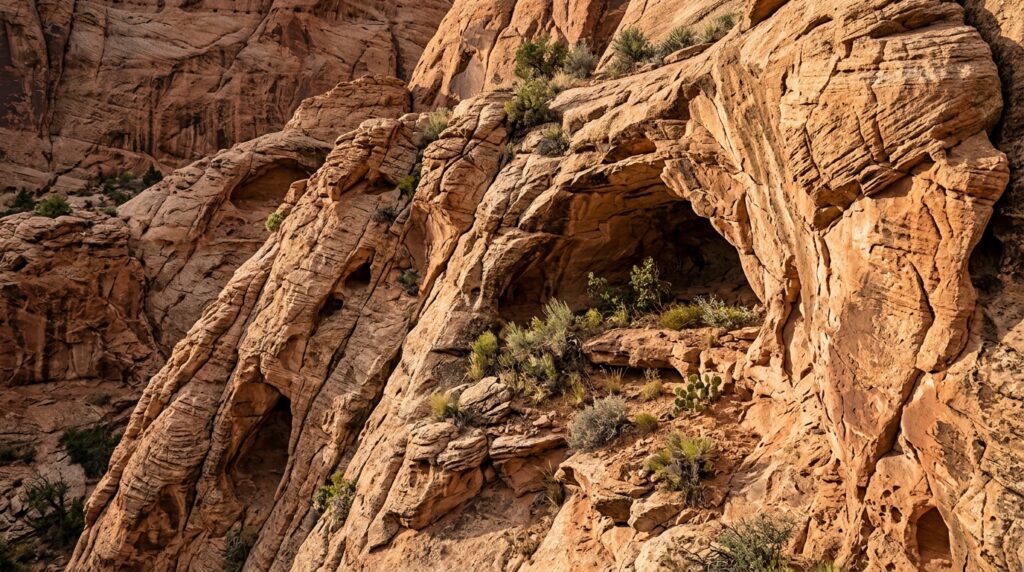
If you look closely at a canyon wall, you will spot a variety of unique features. Cracks and fractures appear as the rock settles and shifts under immense pressure. Over time, these cracks can widen into large caves and alcoves, providing shelter for animals and ancient human civilizations.
You will also find vegetation growing on ledges. Even in harsh environments, hardy plants and trees manage to take root in small pockets of soil that collect on the terraced sections of the wall.
The Base of the Canyon
The canyon floor is the lowest point of the valley, providing the foundation for the entire geological structure.
What Is the Canyon Floor?
The canyon floor is the flat or uneven land located at the very bottom of the canyon. It is the active zone of the canyon, where geological changes are currently taking place. Most canyon floors feature rivers, streams, or dry channels that flow during heavy rainstorms.
Formation of Canyon Floors
Canyon floors form through a continuous cycle of erosion and sediment deposition. As the river flows through the canyon, it carries dirt, sand, and gravel from upstream. When the water slows down, this sediment drops out of the water and builds up on the canyon floor.
River meandering also shapes the floor. As the river snakes back and forth across the valley, it carves a wider path and flattens the bottom. Flooding and erosion cycles constantly rework this landscape, washing away old sediment and depositing new material with every major storm.
Common Features on Canyon Floors
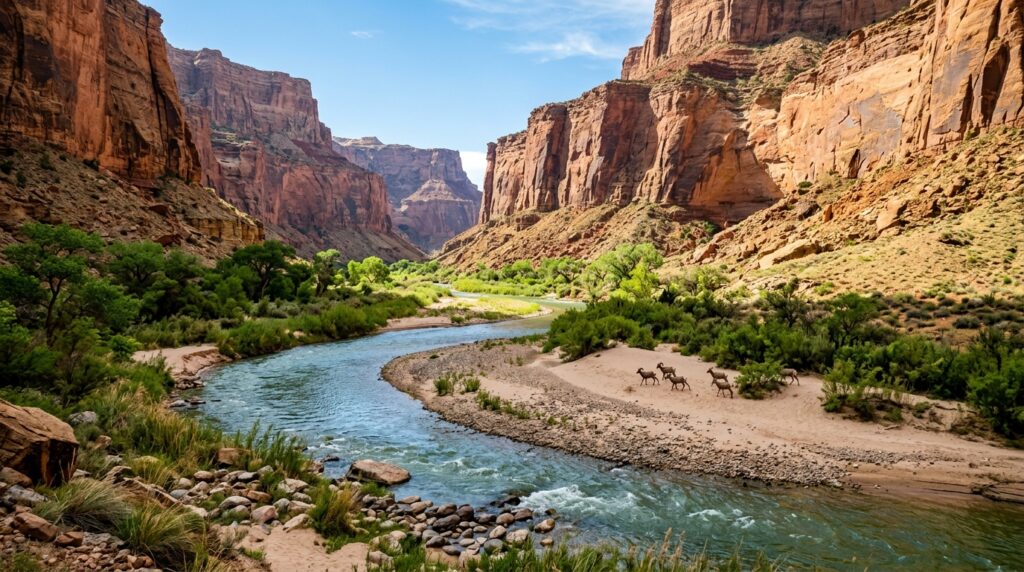
The base of a canyon is a dynamic environment filled with distinct geographical features. Sandbars and gravel beds build up along the inside curves of the river. Floodplains stretch across the wider sections of the floor, providing flat areas where water can spread out during heavy rains.
Because water is available, the canyon floor is often rich with vegetation and wildlife habitats. Trees, bushes, and grasses grow thickly along the riverbanks, creating a green oasis that supports birds, mammals, and insects.
Importance of Canyon Floors
The canyon floor plays a vital role in the surrounding environment. It serves as a natural channel for water flow and drainage, moving water from high mountain elevations down to lakes and oceans.
These floors also support incredible ecosystems and biodiversity. The availability of water and shelter makes them a haven for wildlife in otherwise arid landscapes. Additionally, canyon floors are highly valued for human use and recreation. Hikers, campers, and river rafters flock to the bottom of canyons to explore the pristine wilderness.
Earth’s Geological Record
The rock layers exposed in a canyon wall offer a visible timeline of the planet’s history. These layers are like the pages of a massive history book, waiting to be read.
How Rock Layers Form
Rock layers form through sediment accumulation over millions of years. Dirt, sand, and organic matter settle at the bottom of ancient oceans, lakes, and deserts. Over time, new layers pile on top of the old ones. The immense weight of these materials causes compression and cementation, turning loose sediment into solid rock.
Volcanic and tectonic influences also contribute to the rock layers. Volcanic eruptions deposit thick layers of ash and lava, which harden into rock. Tectonic plates shift and collide, lifting these flat layers high above sea level so rivers can eventually cut through them.
Types of Rocks in Canyons
You will generally find three types of rocks in a canyon. Sedimentary rocks, like sandstone and limestone, are the most common. They form from compressed sediment and typically contain distinct, colorful layers.
Igneous rocks form from cooled magma or lava. They are incredibly hard and often make up the deepest, oldest layers of a canyon. Metamorphic rocks are created when existing rocks are subjected to extreme heat and pressure deep underground, altering their chemical structure.
Reading Earth’s History Through Layers

Scientists use rock layers to read the history of the Earth. Fossils and ancient environments are preserved within the sedimentary layers, showing us what kinds of plants and animals lived millions of years ago.
Climate changes are also recorded in the rock. A layer of sandstone indicates that the area was once a dry desert, while a layer of limestone suggests it was covered by a warm, shallow sea. By studying these bands of rock, geologists can build accurate geological timelines of the planet’s past.
Differential Erosion and Layer Appearance
Because different rocks erode at different speeds, the canyon walls take on a unique, textured appearance. Hard rock resists erosion, forming steep vertical cliffs. Soft rock wears away quickly, creating gentle, angled slopes.
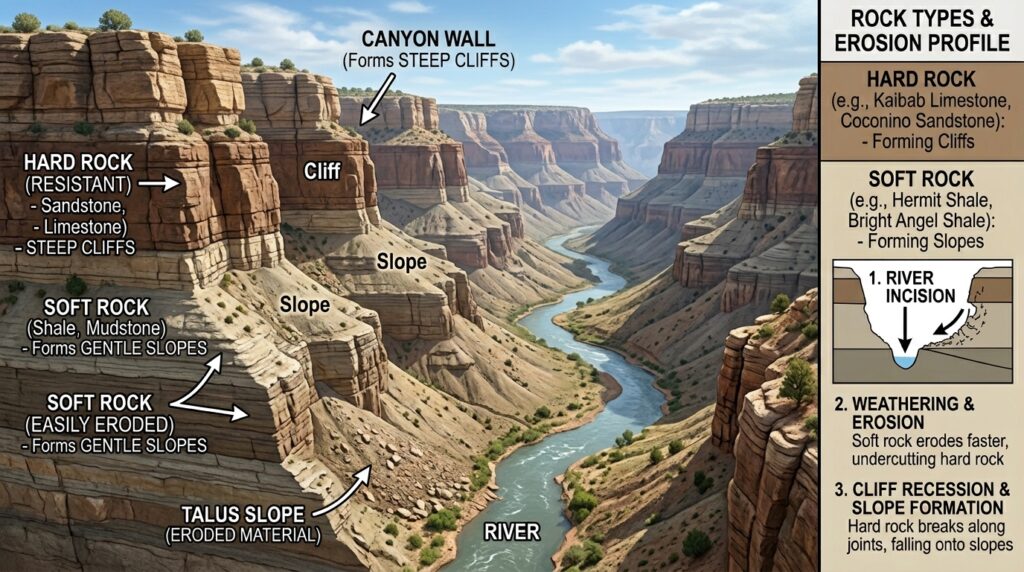
This process, known as differential erosion, is responsible for the stair-step shape of many canyon walls. It also creates beautiful color variations. Minerals like iron rust to create brilliant reds and oranges, while other minerals leave streaks of yellow, green, and gray across the rock face.
The Role of Rivers in Shaping Canyon Anatomy
Rivers are the primary architects of canyon anatomy. They perform the heavy lifting required to carve deep valleys out of solid rock. A river achieves this through downcutting into the rock layers. The flowing water uses sand, gravel, and boulders as abrasive tools to grind away the bedrock, slowly deepening the channel.
The transportation of sediment is equally important. A river must carry away the debris it erodes, clearing the path so further downcutting can occur. Seasonal flooding impacts this process heavily. During a flood, a river’s speed and volume increase dramatically, allowing it to move massive boulders and carve out the canyon floor at a rapid pace.
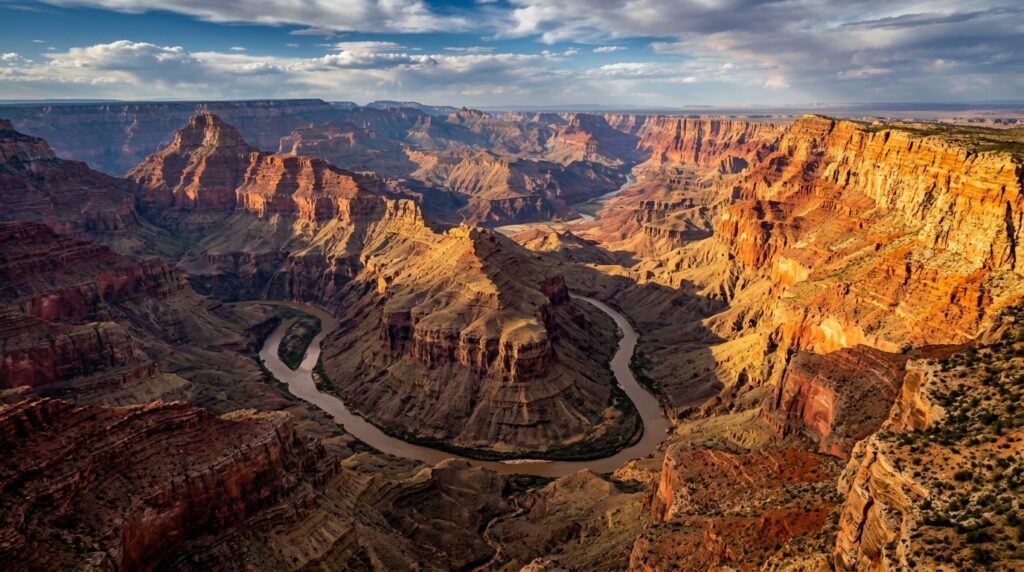
The Colorado River is a perfect example of this process. Over the last six million years, the powerful flow of the Colorado River has sliced through the Kaibab Plateau, shaping the immense and awe-inspiring anatomy of the Grand Canyon.
Weathering and Erosion Processes
While rivers cut downward, weathering processes widen the canyon and shape the walls.
Mechanical Weathering
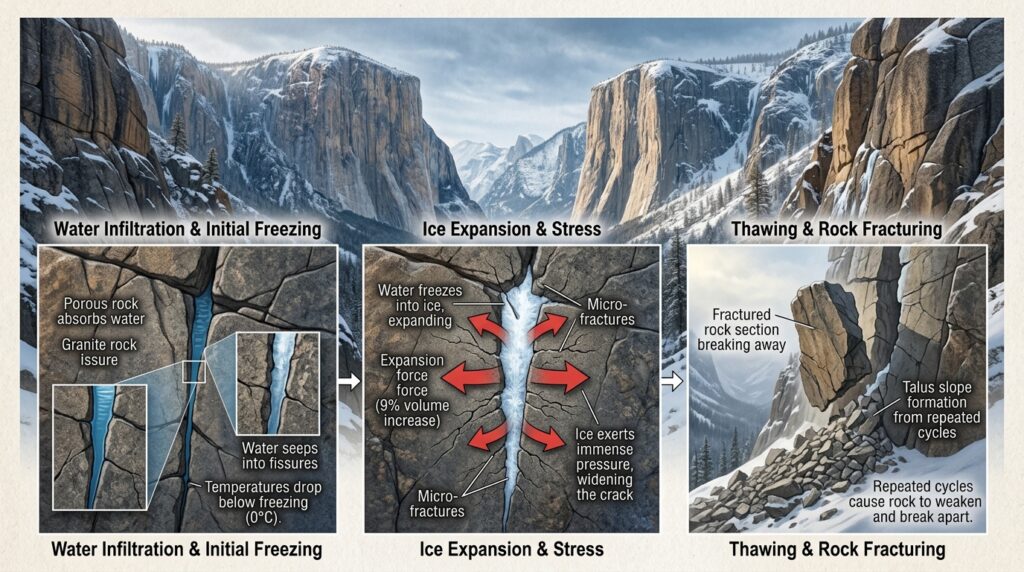
Mechanical weathering physically breaks rock apart without changing its chemical makeup. Freeze-thaw action is a major driver of this process. Water seeps into cracks in the rock during the day. When temperatures drop at night, the water freezes and expands, wedging the rock apart. Repeated expansion and contraction eventually causes the rock to shatter.
Chemical Weathering
Chemical weathering alters the minerals within the rock, causing them to dissolve or weaken. Rainwater naturally contains a small amount of acid, which slowly dissolves minerals over time. This process is especially effective on limestone and sandstone, wearing away the rock and forming large caves and sinkholes in the canyon walls.
Biological Weathering
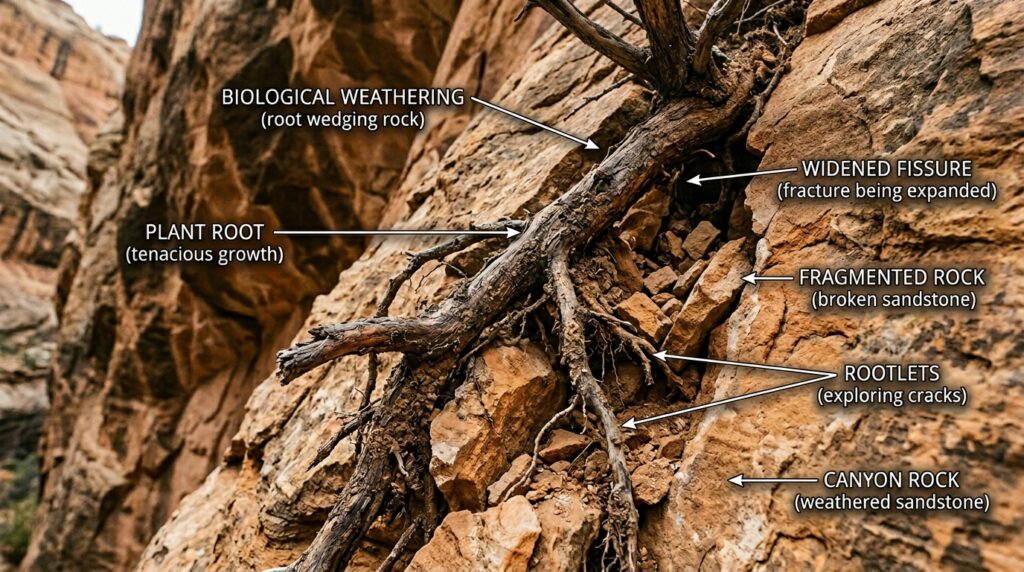
Biological weathering is caused by living organisms. Plant roots grow into small cracks in the rock, slowly expanding and forcing the stone apart as the plant grows larger. Microorganisms like lichens also grow on the rock surface, releasing mild acids that slowly break down the minerals underneath.
Different Types of Canyons and Their Structures
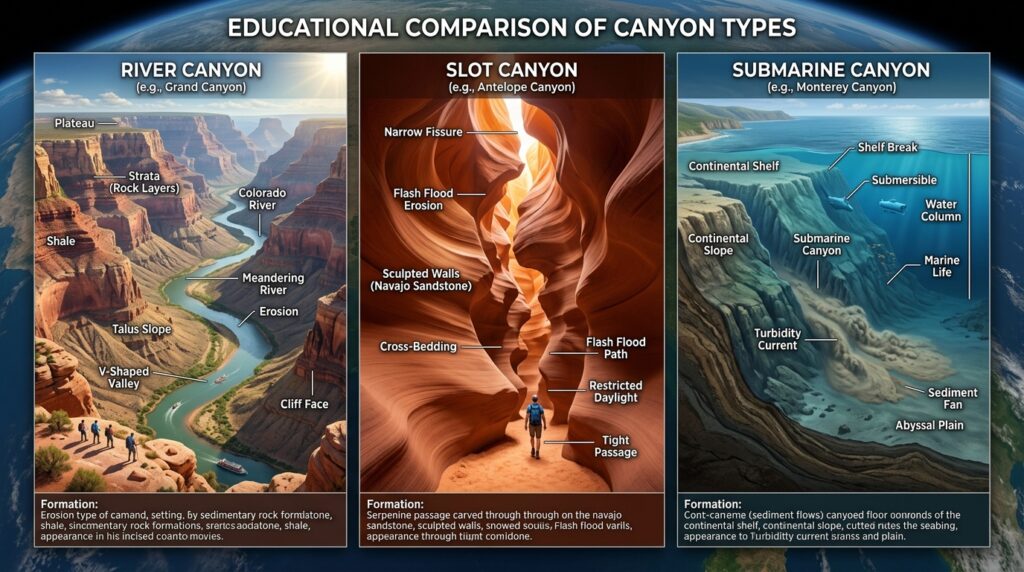
Canyons appear in a variety of forms depending on how and where they are created.
River Canyons
River canyons are the most common type. They are formed mainly by flowing water cutting through elevated plateaus. These canyons typically feature a V-shape, with a distinct river actively flowing along the floor.
Slot Canyons
Slot canyons are extremely narrow and surprisingly deep. They are formed by sudden flash floods rushing through cracks in soft sandstone. The surging water scours the walls, creating smooth, twisting corridors. Antelope Canyon in Arizona is a famous example, known for its flowing rock shapes and spectacular light beams.
Submarine Canyons
Not all canyons are found on land. Submarine canyons are massive, steep-sided valleys located underwater along the edges of continents. They are carved by powerful ocean currents and underwater landslides. These canyons play a crucial role in ocean geology, channeling nutrient-rich water from the deep sea up to the coast.
Famous Canyons and Their Unique Anatomy

Every canyon has a unique anatomy that reflects its local geology and climate.
Grand Canyon
The Grand Canyon in the United States is famous for its massive scale and brilliantly colored, layered rock formations. The immense canyon walls showcase nearly two billion years of Earth’s history, dropping down to the raging Colorado River below.
Bryce Canyon
Bryce Canyon is not a true river canyon, but a massive natural amphitheater created by frost weathering. It is famous for its hoodoos, which are tall, thin spires of rock rising from the canyon floor. These unusual rock shapes are created by differential erosion, leaving behind delicate pillars of hard stone.
Copper Canyon
Located in Mexico, Copper Canyon is actually a complex canyon system made up of six distinct rivers. The walls of Copper Canyon are heavily forested and drop deeper than the Grand Canyon in certain places. Its complicated network of intersecting valleys makes it one of the most rugged landscapes in the world.
How Scientists Study Canyon Structures
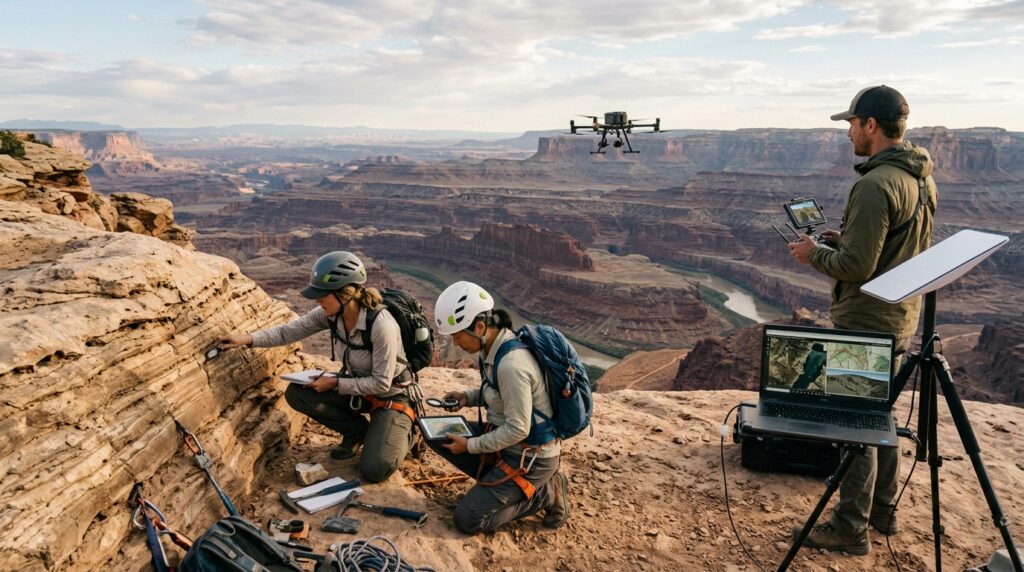
Geologists use a variety of tools to understand how canyons form and change. Geological mapping helps scientists plot the different rock layers and track how they move across a landscape. Rock dating methods allow researchers to determine exactly how old a particular rock layer is by measuring the radioactive decay of specific minerals.
Modern technology has made studying canyons much safer and more accurate. Satellite imaging and drones provide high-resolution maps of steep, inaccessible canyon walls. Scientists also study fossils and sediment samples collected from the canyon floor to piece together a picture of what the climate and environment looked like millions of years ago.
Why Canyon Anatomy Matters
Studying canyon anatomy provides critical knowledge for modern society. It allows us to understand Earth’s history by providing a clear window into the distant past. Geologists use this information to track long-term climate changes and tectonic movements.
Understanding the mechanics of canyon erosion also helps us predict erosion and landslides. By studying how rocks weaken and fall, scientists can better protect roads, bridges, and communities located near steep slopes. Furthermore, canyons are vital for protecting ecosystems and natural landmarks. They provide refuge for endangered species and offer immense educational and tourism value, inspiring millions of visitors each year to appreciate the natural world.
Preserving Our Deepest Landscapes
The walls, floors, and rock layers of a canyon come together to form a complex and beautiful geological structure. Every canyon is a product of relentless erosion, powerful rivers, and deep geological time. By cutting through the earth’s crust, these deep valleys reveal the dynamic processes that continue to shape our world.
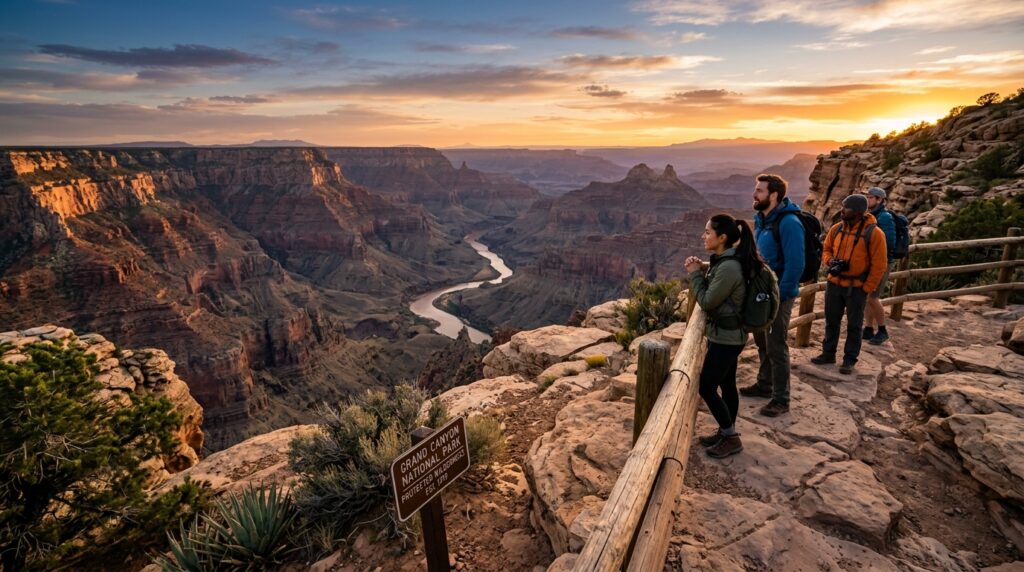
As we continue to study and enjoy these breathtaking landscapes, it is vital that we respect the delicate balance of forces that created them. By protecting canyon ecosystems and practicing responsible tourism, we can ensure that these ancient stone valleys remain wild and vibrant for future generations to explore.